


PCB Pad Solderability Failure Analysis: From Defect Location To Root Cause Cracking
2026-05-16 09:39In PCBA production, poor pad solderability is the primary cause of soldering defects, which are commonly manifested as non-wetting, semi-wetting, tin shrinkage, poor tin penetration, pinhole bubbles, virtual soldering, cold soldering, etc. Failure analysis is not a simple replacement of materials, but a standardized process of "on-site observation→ sample preparation→ instrument detection→ mechanism derivation →process verification" to accurately locate the root cause of defects and avoid recurrence.
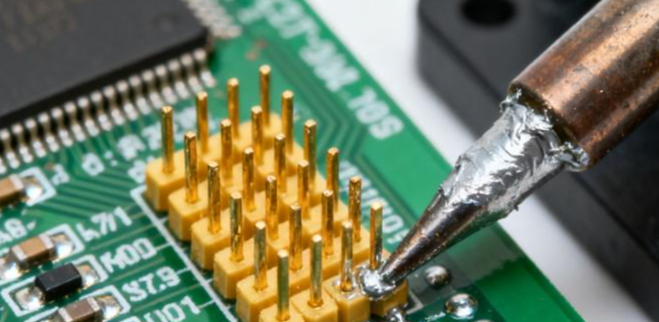
Step 1: On-site defect collection and preliminary judgment
No wetting: the solder is not spread at all, the metal of the pad is exposed, and there is no adhesion → There is a high probability that the pad is severely oxidized, organic contaminated, and the plating fails completely;
Semi-wetting: solder spreads first and then retracts, partially exposed → local defects in the coating, light oxidation, and insufficient flux activity;
Shrinkage: The solder shrinks into a spherical shape, and only dots are attached to → the surface energy is extremely low, heavy pollution, and the OSP film is completely destroyed.
Poor tin penetration: the through-hole hole wall is not wetted → hole wall pollution, coating leakage, insufficient preheating, and the dip soldering time is too short;
Pinhole bubbles: cavities in the solder layer → the board absorbs moisture, flux water vapor, and pad oxide layer decomposition;
Black discs are accompanied by non-wetting: ENIG pads are blackened → typical nickel layer corrosion failure.
Step 2: Standardized solderability retest verification
Step 3: Laboratory instrument in-depth testing
- Metallography Microscope / SEM Scanning Electron Microscope Observe the microscopic morphology of the pad: oxide layer thickness, plating pinholes, peeling, black nickel, whiskers, organic residues, and IMC layer morphology. The SEM can be magnified up to thousands of times to clearly identify nanoscale defects such as corroded holes in the nickel layer of ENIG black disks, OSP film breakage cracks.
- EDS energy spectroscopy detects the elemental composition of the pad surface: if there is a high content of O (oxygen), it indicates severe oxidation; high content of C (carbon), which proves organic pollution; High content of S (sulfur)/Cl (chlorine), proving corrosion of sulfide / chloride ions; ENIG pads have too low Au content and abnormal Ni content, proving that the plating is ineffective.
- XRF Coating Thickness Gauge Non-destructive measurement of coating thickness: OSP film thickness of 0.2~0.5μm is qualified, ENIG nickel layer is 3~5μm, gold layer 0.05~0.15μm is qualified, and the thickness of immersion tin/silver layer is up to standard. Insufficient or severely uneven thickness directly leads to the failure of weldability.
- Surface cleanliness test (ion contamination test) detects ion residues on the surface of the pad: chloride ions, sodium ions, potassium ions, etc. exceed the standard, which will damage the wetting interface, cause corrosion and soldering rejection. Industry standards require ionic contamination < 1.56 μg/cm² (NaCl equivalent).
- Wetting Balance Tester Quantitative Analysis of Wetting Force - Time Curve: Compared with qualified samples, defective samples usually show negative wetting force, too long wetting time, 90% of F5
Step 4: Failure mechanism derivation and root cause localization
Typical failure case 1: OSP board does not wet a large area
Typical Failure Case 2: ENIG pad semi-wetted + black disk
Typical failure case 3: Vulcanization of immersed silver plate refuses welding
Typical failure case 4: Poor tin spraying plate penetration
Typical failure case 5: Batch tin reduction
Step 5: Process verification and improvement plan implementation
Coating defect improvement: OSP coating parameters are adjusted to ensure uniform film thickness; Optimize ENIG nickel gold process to eliminate black disks; strengthen electroplating control to avoid leakage and peeling;
Pollution control improvement: upgrade the cleaning process to reduce ionic residue; Perform anti-static and dust-free operation, and do not touch the pad with bare hands; optimize the solder mask process to prevent ink overflow;
Storage and transportation improvement: strict vacuum packaging, increase desiccant and humidity card; Perform FIFO management and control storage cycles; Improve storage temperature and humidity to avoid sulfide/chloride ion pollution;
Process matching improvements: optimized welding temperature/time/preheating to match surface treatment types; Choose the adapted flux to improve activity and compatibility;
Control and upgrade: increase the proportion of factory weldability sampling inspection, increase aging testing for key products; establish a re-inspection system for incoming materials, and compulsory testing of overdue plates.